 |
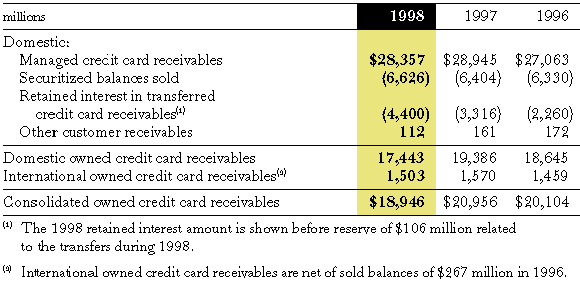
| ANAYLSIS OF CONSOLIDATED FINANCIAL CONDITION The Company's significant financial capacity and flexibility are exemplified by the quality and liquidity of its assets and by its ability to access multiple sources of capital. The owned credit card receivables balance of $18.95 billion excludes credit card receivables transferred to a securitization Master Trust ("Trust"). Through its subsidiary, SRFG, Inc., the Company sells securities backed by a portion of the receivables in the Trust to provide funding. In addition to the receivables in the Trust which back securities sold to third parties, the Company transfers additional receivables to the Trust in accordance with the terms of the securitization transactions and to have receivables readily available for future securitizations. A summary of these balances at year end is as follows:
 The credit card receivable
balances are geographically diversified within the United States and
Canada. The Company grants retail consumer credit based on the use of
proprietary and commercially available credit histories and scoring
models. The Company promptly recognizes uncollectible accounts and
maintains an adequate allowance for uncollectible accounts to reflect
losses inherent in the owned portfolio as of the balance sheet date. The credit card receivable
balances are geographically diversified within the United States and
Canada. The Company grants retail consumer credit based on the use of
proprietary and commercially available credit histories and scoring
models. The Company promptly recognizes uncollectible accounts and
maintains an adequate allowance for uncollectible accounts to reflect
losses inherent in the owned portfolio as of the balance sheet date.
Inventories are primarily valued on the last-in, first-out or LIFO method. Inventories would have been $679 million higher if valued on the first-in, first-out or FIFO method at January 2, 1999. Inventories on a FIFO basis totaled $5.50 billion at January 2, 1999, compared to $5.76 billion at January 3, 1998. The decrease in inventory levels reflects the November 2, 1998, sale of Western Auto. Excluding the Western Auto inventory at year-end 1997, inventory increased $91 million due to additional inventory needed to support the addition of new Full-line and Specialty Stores. CAPITAL RESOURCES
 In 1998, the Company reduced
the percentage of short-term borrowings and increased fixed-rate,
longer-term debt and securitization funding in its funding mix as interest
rate conditions were favorable in the term debt markets. The Company
accesses a variety of capital markets to preserve flexibility and
diversify its funding sources. The broad access to capital markets also
allows the Company to effectively manage liquidity and repricing risk.
Liquidity risk is the measure of the Company's ability to fund maturities
and provide for the operating needs of its businesses. Repricing risk is
the effect on net income from changes in interest rates. The Company's
cost of funds is affected by a variety of general economic conditions,
including the level and volatility of interest rates. In 1998, the Company reduced
the percentage of short-term borrowings and increased fixed-rate,
longer-term debt and securitization funding in its funding mix as interest
rate conditions were favorable in the term debt markets. The Company
accesses a variety of capital markets to preserve flexibility and
diversify its funding sources. The broad access to capital markets also
allows the Company to effectively manage liquidity and repricing risk.
Liquidity risk is the measure of the Company's ability to fund maturities
and provide for the operating needs of its businesses. Repricing risk is
the effect on net income from changes in interest rates. The Company's
cost of funds is affected by a variety of general economic conditions,
including the level and volatility of interest rates.
To aid in the management of repricing risk, the Company uses
off-balance sheet financial instruments, such as interest rate swaps. The
Company has policies that centrally govern the use of such off-balance
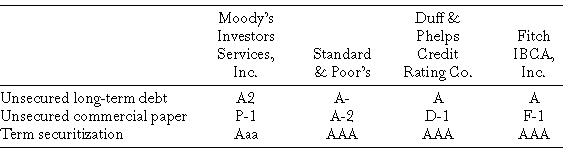
sheet financial instruments. The current ratings of the Company's debt securities appear in the table below:
|

Annual Report Contents | Previous | Next | |